


In today’s digital-first world, businesses are increasingly investing in data and artificial intelligence (AI) to drive innovation, improve decision-making, and gain a competitive edge. From predictive analytics to AI-powered automation, the potential benefits are immense, and for many organizations, the promise of measurable returns is a key motivator.
However, despite the hype, quantifying the Return on Investment (ROI) for data and AI initiatives is far from straightforward. Unlike traditional business projects, the value of these investments often emerges over time, can be indirect, and may not immediately translate into revenue. This complexity makes it crucial for organizations to adopt the right metrics and best practices to assess performance accurately.
In this blog, we’ll explore why businesses are committing resources to data and AI, the challenges in measuring ROI, and practical strategies to evaluate the impact of these investments. By the end, you’ll have a clearer framework to track, measure, and optimize the returns from your data and AI initiatives.
Defining ROI in the Context of Data & AI
ROI, or Return on Investment, is a familiar concept in business: it’s a measure of the financial gain generated from an investment relative to its cost. The traditional formula is straightforward:
For conventional projects, this calculation is often clear-cut, revenue increases, cost savings, or efficiency gains can be directly quantified.
However, when it comes to data and AI initiatives, calculating ROI becomes more nuanced. The value of these investments isn’t always immediately visible or purely financial. Many benefits are intangible, such as improved decision-making, enhanced customer experiences, or risk mitigation. Additionally, the time-to-value, the period before measurable benefits are realized, can be longer than in traditional projects, making short-term ROI assessments less meaningful.
It’s also important to distinguish between direct and indirect ROI:
- Direct ROI refers to measurable, tangible benefits, such as cost reductions from automation, revenue growth from predictive analytics, or efficiency gains in operations.
- Indirect ROI encompasses less quantifiable advantages, like better strategic decision-making, improved data-driven culture, or increased customer loyalty. While these benefits may not immediately reflect on the balance sheet, they often compound over time and contribute significantly to long-term value.
Understanding these distinctions is critical for setting realistic expectations and effectively measuring the impact of data and AI initiatives.
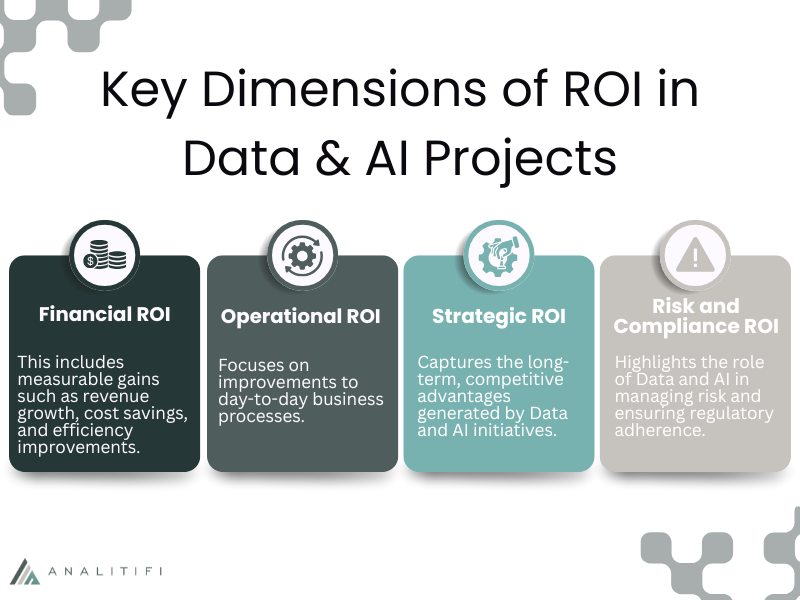
Image created by Analitifi.
Key Dimensions of ROI in Data & AI Projects
Measuring ROI for data and AI initiatives requires looking beyond traditional financial metrics. To get a comprehensive view of value, it’s helpful to consider several key dimensions.
Financial ROI remains the most tangible and widely recognized metric. This includes measurable gains such as revenue growth, cost savings, and efficiency improvements. For example, AI-driven insights can help increase sales through better targeting or pricing optimization, while automation and predictive analytics can reduce operational costs and streamline resource allocation. These benefits are often the easiest to quantify and are typically the first indicators of a successful investment.
Operational ROI focuses on improvements to day-to-day business processes. Data and AI can streamline workflows, automate repetitive tasks, and reduce errors, leading to increased productivity and reliability. For instance, predictive maintenance can minimize downtime in manufacturing, while AI-powered process monitoring can identify inefficiencies before they become costly problems. These operational gains may not always translate immediately into revenue, but they significantly enhance the overall performance and resilience of an organization.
Strategic ROI captures the long-term, competitive advantages generated by data and AI initiatives. Beyond immediate financial or operational gains, organizations can use AI to innovate, differentiate their products or services, and create entirely new business models. These investments can strengthen a company’s market position, unlock new revenue streams, and foster a culture of innovation, delivering value that grows over time and extends far beyond the balance sheet.
Risk and Compliance ROI highlights the role of data and AI in managing risk and ensuring regulatory adherence. AI can enhance fraud detection, monitor compliance with evolving regulations, and bolster cybersecurity through predictive threat detection. While these benefits may not always be directly measurable in terms of dollars, they are critical for protecting an organization’s reputation, avoiding penalties, and maintaining trust with customers and stakeholders.
By evaluating ROI across these financial, operational, strategic, and risk-focused dimensions, organizations gain a more holistic understanding of the true impact of their data and AI investments, ensuring that both tangible and intangible benefits are captured and communicated effectively.
Measuring ROI: A Step-by-Step Framework
Measuring ROI for data and AI initiatives begins with clearly defining business objectives upfront. Every data or AI project should be directly tied to key performance indicators (KPIs) that reflect the outcomes the organization wants to achieve. Whether the goal is to increase revenue, reduce costs, improve customer experience, or enhance operational efficiency, aligning data and AI initiatives with measurable objectives ensures that the value of the investment can be properly assessed.
The next step is to identify all associated costs. These extend beyond just technology expenses and include data infrastructure, analytics platforms, AI tools, data acquisition and management, talent recruitment, training, and integration with existing systems. Accounting for the full spectrum of costs is essential to avoid underestimating the investment and to provide a realistic foundation for ROI calculation.
Tracking benefits comes next, encompassing both quantitative and qualitative gains. Quantitative benefits might include cost reductions, revenue growth, or efficiency improvements, while qualitative benefits may involve better decision-making, enhanced customer satisfaction, or improved employee productivity. Capturing both types of gains ensures a comprehensive understanding of the value generated from data and AI efforts.
Establishing baseline metrics before implementing data and AI initiatives is critical. These baselines provide a point of comparison to measure improvements and demonstrate the impact of these initiatives over time. Without baseline metrics, it is difficult to determine whether observed changes are a result of the data or AI project or other external factors.
It is also important to measure both short-term and long-term impacts. Some benefits, like data process automation or faster analytics, may be realized quickly, while strategic advantages, such as data-driven innovation and competitive differentiation, often take longer to materialize. Evaluating ROI across different time horizons provides a more complete picture of the initiative’s overall value.
Finally, calculate ROI using the appropriate metrics based on the identified costs and benefits. This may involve traditional financial ROI formulas, adjusted to account for indirect or intangible gains. By following this structured framework, organizations can accurately assess the performance of their data and AI investments and make informed decisions about future projects.
Common Metrics to Track
Effectively measuring the ROI of data and AI initiatives requires tracking metrics that capture both financial and operational impact. One of the most direct measures is revenue uplift. Data analytics and AI models can significantly boost profitability by enabling personalized recommendations, predictive pricing, and enhanced customer targeting. Data-driven insights help organizations identify new revenue opportunities, optimize product offerings, and improve marketing efficiency, while AI capabilities automate decision-making and scale these improvements across the business. According to Accenture, AI has the potential to increase profitability by up to 38% by 2035, contributing an estimated $14 trillion to the global economy.
Cost savings are another key benefit, as data-driven insights and AI-powered automation enable process optimization, reduce manual work, and improve operational efficiency, highlighting the tangible financial advantages of adopting these technologies.
Data and AI initiatives also enhance employee productivity, freeing teams from repetitive tasks and enabling them to focus on higher-value work. Studies show that AI adoption in HR and other operational functions can improve team productivity by around 20%, according to Worklytics. In addition, data analytics and AI models help reduce time-to-decision and time-to-market, enabling organizations to respond more quickly to business opportunities. Generative AI tools, for example, can accelerate coding and content creation, shortening overall project timelines.
Additionally, data and AI systems contribute to error reduction and quality improvements. By automating and validating processes, they enhance consistency, reduce operational errors, and improve the overall quality and reliability of products and services.
By consistently tracking these metrics, organizations gain a holistic view of the value generated by their data and AI initiatives, capturing both tangible and intangible benefits and ensuring that investments are delivering measurable impact.
Challenges in Measuring ROI
Measuring ROI for data and AI initiatives presents several challenges. Outcomes often result from multiple factors, including data insights, process changes, or market conditions, making it difficult to attribute improvements solely to these projects. Success depends not just on technology, but also on data quality, organizational readiness, and strategic alignment.
Projects involving data and AI can take time to develop, test, and deploy, delaying the realization of benefits. They also generate intangible gains, such as enhanced decision-making, improved customer experiences, and increased employee satisfaction, which are hard to quantify in traditional ROI assessments. Poor data quality can further undermine results, highlighting the need for clean, complete, and ethically governed data.
The effectiveness of these initiatives depends heavily on strong data management practices, including cleaning, validation, and handling missing or inconsistent information. Addressing these challenges requires a comprehensive evaluation framework that captures both tangible and intangible benefits, providing a more accurate picture of ROI.
Best Practices for Maximizing and Proving ROI
To maximize and demonstrate the ROI of data and AI initiatives, organizations should adopt a strategic and structured approach:
- Start with pilot programs. Launching small-scale data or AI projects allows organizations to test concepts, refine models, and gather real-world feedback before committing significant resources. Running pilots alongside existing processes enables direct comparisons and identifies potential challenges early.
- Define clear and measurable success metrics. These metrics should align with business objectives and be agreed upon by all stakeholders, ensuring consistent expectations and accountability.
- Use real-time dashboards. Monitoring key performance indicators (KPIs) through dashboards allows organizations to track the performance of data and AI initiatives continuously, facilitating timely adjustments and alignment with business goals.
- Account for evolving ROI. The value of data and AI projects can increase over time as models improve and business processes adapt. Regular reassessment and iteration help capture the full potential of these investments.
- Communicate value effectively. Translating technical outcomes into business terms, such as increased revenue, cost savings, or improved customer satisfaction, ensures that the impact of data and AI initiatives is understood across the organization.
By following these best practices, organizations can enhance the effectiveness of their data and AI initiatives and demonstrate their value in a way that resonates with all stakeholders.
Conclusion
Measuring ROI is essential for justifying investments in data and AI initiatives. Without a clear understanding of the value generated, organizations may struggle to prioritize projects, secure funding, and scale initiatives effectively. A comprehensive ROI approach combines quantitative metrics, such as revenue growth and cost savings, with qualitative value, including improved decision-making, enhanced customer experiences, and a data-driven organizational culture.
Businesses that measure ROI effectively are better positioned to scale data and AI projects with confidence. By tracking the right metrics, continuously monitoring performance, and communicating results in business terms, organizations can ensure their initiatives deliver tangible impact and long-term strategic advantage.
To take the guesswork out of measuring and maximizing ROI from data and AI initiatives, explore how Analitifi can help your organization track performance, uncover insights, and demonstrate real business value, turning your investments into measurable results.