


Dynamic pricing is a strategy where businesses adjust prices in real time based on factors such as demand, competition, and customer behavior. It’s a technique long used by industries like airlines and hospitality, but in today’s fast-paced, data-driven markets, it has become essential across e-commerce, mobility, and SaaS as well. Static pricing models often fall short because consumers expect flexibility, competitors react quickly, and external factors like seasonality or supply chain disruptions can shift the market overnight.
This is where machine learning is transforming traditional pricing models. By analyzing vast amounts of data and uncovering patterns that humans might miss, machine learning enables businesses to make smarter, faster, and more precise pricing decisions. Instead of relying on rules or guesswork, companies can use AI-driven insights to optimize revenue, stay competitive, and deliver better customer experiences.
In this blog, we’ll explore what dynamic pricing is, how machine learning enhances it, the core components of ML-powered pricing systems, and the most popular strategies being used today, from personalized and time-based pricing to competitive and value-based approaches. We’ll also look at real-world applications, the benefits and risks of adopting these strategies, and best practices for implementation. By the end, you’ll have a clear understanding of how machine learning is reshaping dynamic pricing and why it’s becoming an essential tool for modern businesses.
What is Dynamic Pricing?
Dynamic pricing is a strategy that allows businesses to adjust product or service prices in response to changing market conditions. Instead of relying on fixed pricing, companies use data on factors like demand, competitor prices, time of day, and customer behavior to determine the optimal price at any given moment. This approach helps businesses maximize revenue while remaining competitive and responsive to consumer needs.
Classic examples of dynamic pricing can be seen in industries such as airlines, ride-hailing, and hospitality. Airline tickets fluctuate daily based on booking patterns and seasonality, ride-hailing apps increase fares during peak demand through surge pricing, and hotels adjust room rates depending on occupancy levels. In e-commerce, giants like Amazon also employ dynamic pricing to reflect competition and shopping behavior in real time.
While the benefits are clear, higher revenue potential, better market alignment, and personalized customer offers, traditional dynamic pricing models have their limitations. They often rely on predefined rules and historical data, making them less flexible when new market trends emerge. This is where machine learning takes dynamic pricing to the next level, enabling businesses to adapt with precision and speed.
Role of Machine Learning in Dynamic Pricing
Machine learning is revolutionizing the way businesses approach dynamic pricing by making pricing models more accurate, adaptable, and data-driven. Unlike traditional rule-based systems that rely heavily on static formulas and historical averages, machine learning algorithms can continuously learn from new data, detect patterns, and adjust prices in real time. This creates a system that not only reacts quickly to market changes but also anticipates them.
Several key machine learning techniques are commonly applied to pricing strategies. Regression models help identify relationships between factors such as demand, time, customer segments, and price sensitivity. Reinforcement learning takes it a step further by allowing algorithms to “learn” the optimal pricing strategy through trial and error, improving over time as feedback is collected. Another powerful approach is demand forecasting, where algorithms predict customer demand based on historical data, seasonal trends, and external factors, helping businesses set prices proactively rather than reactively.
A major strength of machine learning in pricing lies in its flexibility between real-time and batch models. Real-time pricing models are particularly useful in fast-moving industries like ride-hailing or e-commerce, where customer demand and competitor activity shift by the minute. Batch pricing models, on the other hand, are better suited for industries with less frequent price changes, such as SaaS or subscription businesses, where daily or weekly updates are enough to stay aligned with market conditions.
By leveraging these methods, businesses can move beyond manual rule-setting and unlock dynamic pricing systems that are smarter, faster, and more responsive to customer and market signals.
Core Components of ML-Powered Dynamic Pricing
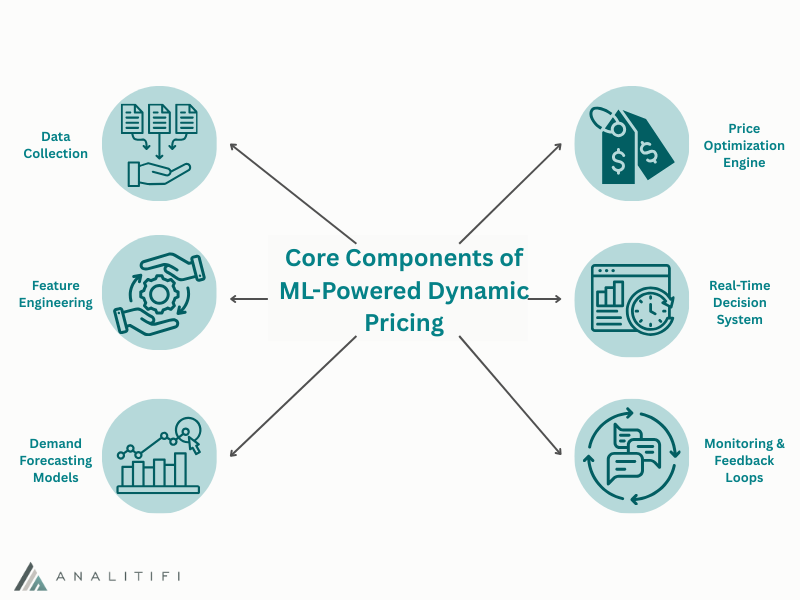
Building an effective machine learning–driven dynamic pricing system requires more than just algorithms. It’s a combination of robust data pipelines, intelligent feature engineering, carefully chosen models, and ongoing optimization. Let’s break down the key components:
Data Collection
The foundation of dynamic pricing lies in high-quality data. Businesses need to gather information from multiple sources, including:
- Customer behavior (purchase history, browsing patterns, click-through rates)
- Competitor pricing (real-time market benchmarks)
- Seasonal and external trends (holidays, demand spikes, supply chain shifts)
Without a diverse and reliable dataset, even the most advanced models will produce poor recommendations.
Feature Engineering
Raw data becomes actionable only after it’s transformed into meaningful features. In dynamic pricing, this may include:
- Demand elasticity — how sensitive customers are to price changes
- Time sensitivity — urgency of purchase, such as last-minute bookings
- Customer segmentation — grouping customers by behavior, demographics, or loyalty
Good feature engineering can often have a bigger impact on model performance than tweaking the algorithm itself.
Model Training
The choice of machine learning model depends on business goals and data availability:
- Supervised learning is used when labeled historical data is available (e.g., past sales and prices), making it possible to predict optimal price points.
- Unsupervised learning helps uncover hidden patterns like customer clusters or demand segments, useful when labels are sparse.
Some companies even use hybrid models to balance predictive power with exploratory insights.
Continuous Optimization
Pricing is not a “set it and forget it” system. Market dynamics, customer preferences, and competitor strategies shift constantly. That’s why feedback loops are essential. By feeding real-world results (conversion rates, revenue impact, churn) back into the system, models can adapt and refine pricing strategies in near real-time.
Popular Dynamic Pricing Strategies Enhanced by ML

ML also enhances competitive pricing by monitoring rival prices in real time and dynamically adjusting to remain attractive without sacrificing profitability. Instead of relying on manual checks, algorithms allow businesses to stay agile in fast-moving markets. Finally, value-based pricing benefits from machine learning’s ability to analyze customer feedback, usage data, and even sentiment to better understand perceived value. This ensures that prices reflect what customers are truly willing to pay, strengthening brand positioning and customer trust.
Real-World Applications & Case Studies
ML-powered dynamic pricing increasingly transforms how industries optimize revenue, manage inventory, and delight customers.
In travel and hospitality, airlines and hotels employ AI-enhanced revenue management to fine-tune prices. For example, airlines use AI to constantly tweak prices, tracking factors like booking trends and competitor rates. Marriot hotels use AI-driven forecasting tools that enhance their competitiveness, increase market share, and maximize hotel revenue.
Mobility and logistics platforms like Uber use ML-powered surge pricing to maintain balance between demand and supply, raising fares in high-demand periods to attract drivers, thereby ensuring ride availability and enhancing profitability. On the logistics side, Amazon’s AWS has helped logistics service providers (LSPs) implement dynamic pricing that improves demand forecasting and margin optimization. One LSP achieved a 13% improvement in forecasting accuracy and a 4% increase in overall gross margin across multiple routes.
Ethical Considerations & Risks
While ML-powered dynamic pricing can deliver significant business value, it also raises ethical and operational challenges that must be carefully managed.
One of the biggest concerns is the risk of customer backlash. Consumers may perceive surge pricing or sudden fluctuations as unfair, especially during emergencies or high-demand events. For instance, ride-sharing platforms like Uber have faced criticism when surge pricing resulted in disproportionately high fares during crises. If left unaddressed, these situations can erode trust and brand loyalty.
Another issue is data privacy and fairness. Dynamic pricing relies heavily on customer data, from browsing behavior to purchase history. Without transparent practices, customers may feel exploited, particularly if they suspect they are being charged differently than others for the same product. There’s also the risk of unintentional bias: algorithms may inadvertently discriminate against certain customer groups if not carefully designed and audited.
Finally, businesses must navigate regulatory considerations. Authorities worldwide are increasing scrutiny over algorithmic pricing, especially when it comes to anti-competitive practices or discriminatory outcomes. For example, the European Union and U.S. regulators are actively reviewing how automated pricing impacts consumer rights and market fairness. Compliance with consumer protection and competition laws is not optional, it’s critical for sustainable growth.
Best Practices for Implementing ML in Pricing
Successfully deploying ML-powered pricing requires more than just advanced algorithms, it demands a disciplined, transparent, and iterative approach. The first step is to start with high-quality data. Clean, comprehensive, and relevant datasets are the foundation of reliable pricing models. Incomplete or biased data can lead to poor predictions, unfair pricing, or customer dissatisfaction.
Next, it’s important to use interpretable models where possible. While complex black-box models may deliver high accuracy, they can make it difficult to explain pricing decisions to stakeholders or regulators. Interpretable models or at least explainability layers, help build trust with both customers and internal teams by clarifying why certain prices were chosen.
Equally critical is the need to continuously monitor performance. Pricing models operate in fast-changing environments where customer behavior, competitor actions, and market conditions shift constantly. Without active monitoring and recalibration, even the best models can quickly become outdated or counterproductive.
Finally, companies should A/B test pricing models before full rollout. Controlled experiments allow businesses to evaluate performance in real-world conditions, identify risks early, and measure outcomes such as conversion rates, revenue lift, and customer satisfaction. By starting small and scaling gradually, businesses can minimize risk while maximizing confidence in their dynamic pricing strategy.
Conclusion
Machine learning is reshaping the way businesses think about pricing. By leveraging customer data, market signals, and real-time insights, companies can move beyond static price tags to adopt smarter, more flexible pricing strategies that maximize revenue while keeping customers engaged. From e-commerce and travel to logistics and SaaS, real-world applications show how ML not only drives profitability but also enhances competitiveness in rapidly shifting markets.
Looking ahead, the future of dynamic pricing is deeply tied to AI-driven decision-making. As models become more sophisticated and interpretable, businesses will be able to personalize prices, respond instantly to market changes, and align value with customer expectations, all while navigating ethical and regulatory challenges. Those who adopt early will be better positioned to lead in their industries.
At Analitifi, we help businesses harness the power of ML to design, test, and implement dynamic pricing strategies tailored to their unique needs. If you’re ready to explore how ML-powered pricing can transform your revenue growth and keep you ahead of the competition, contact us today and let’s take the next step.