

Amazon is a global powerhouse, not just in e-commerce, but in logistics, automation, and supply chain management. With over 1.6 million employees worldwide, fulfillment centers across multiple continents, and the ability to deliver millions of items within a day or two, its scale is nearly unmatched. Managing a supply chain of this magnitude demands more than just manpower, it requires advanced technology. That’s why Amazon has increasingly turned to artificial intelligence to create an AI supply chain: a system designed to optimize operations at every level, from inventory forecasting to real-time delivery routing.
Every time a package lands on your doorstep within 24 hours, you’re seeing artificial intelligence at work. Behind Amazon’s promise of “fast and free” is a vast AI-powered logistics engine that’s rewriting the rules of global supply chains.
Over the past several years, Amazon has embedded artificial intelligence and machine learning into nearly every part of its logistics engine, from forecasting demand across hundreds of millions of products to coordinating warehouse robots and mapping out last-mile delivery routes in real time.
This blog dives into how Amazon uses AI to stay ahead of global logistics demands, and what companies of any size can learn from its strategy. From warehouse automation to predictive analytics, Amazon’s logistics tech offers a glimpse into the future of supply chain management.
This blog gives you practical takeaways. You’ll learn how to:
- Spot inefficiencies in your supply chain
- Apply predictive analytics to demand planning
- Use automation to reduce labor costs and errors
- Make faster, data-driven logistics decisions

Demand Forecasting with Machine Learning
Behind every lightning-fast delivery from Amazon is a sophisticated system that knew, often days or weeks in advance, that you were likely to place that order. At the heart of this system is machine learning–driven demand forecasting.
Amazon’s ability to anticipate what products customers will want, where, and when, is powered by its proprietary Supply Chain Optimization Technology (SCOT). These forecasting models analyze massive amounts of historical data, tracking past purchases across regions, times of year, and customer segments. But they don’t stop there. Amazon’s models also factor in seasonal patterns, upcoming holidays, major events (like Black Friday or the Super Bowl), and even external variables like weather, which can significantly impact buying behavior (About Amazon).
By using deep learning algorithms, Amazon can generate demand forecasts for over 400 million items daily. These systems are constantly learning and refining their predictions based on real-time purchasing activity, social media signals, supply constraints, and shifting trends (CDO Times).
Accurate forecasting has tangible business benefits. It allows Amazon to stock inventory closer to the customer, reducing the need for long-distance shipping and ensuring faster delivery. It also minimizes overstocking, cutting down on storage costs and product waste. In short, smart forecasting helps Amazon strike a balance between availability and efficiency, all while keeping operations lean and responsive.
And once those items are stocked in the right place at the right time, the next challenge begins: moving them quickly and efficiently. That’s where Amazon’s smart warehousing strategy comes into play.
Amazon’s Use of Robotics and AI for Smart Warehousing Efficiency
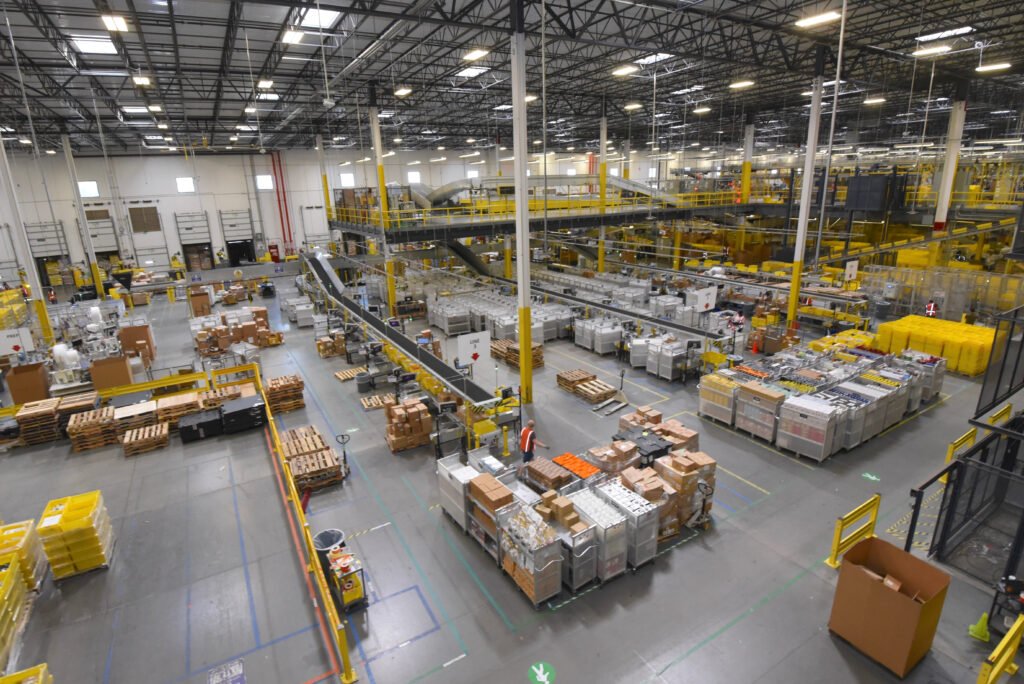
Of course, predicting what customers will order is only half the battle. Once an item is in stock, it has to be picked, packed, and shipped, fast. That’s where Amazon’s next layer of AI innovation comes into play: smart warehousing and robotics.
Inside Amazon’s fulfillment centers, fleets of AI-powered robots, including models like Proteus, Robin, and the earlier Kiva systems, work alongside human associates to move products with incredible precision and speed. These robots handle everything from lifting heavy shelves to delivering bins to packing stations, drastically reducing the time it takes to process an order (About Amazon, Business Insider).
The focus goes beyond moving boxes. Amazon’s warehouses are equipped with real-time inventory tracking systems that know exactly where every item is stored. Using AI, these systems continuously optimize storage layouts, keeping high-demand items closer to packing stations and dynamically adjusting placement based on demand forecasts.
AI also determines the most efficient picking routes within a fulfillment center, guiding both humans and robots to retrieve items in the shortest time possible. This level of optimization helps Amazon reduce fulfillment times, cut labor costs, and keep delivery promises, even during peak seasons.
Together, these smart systems allow Amazon to process millions of orders a day with astonishing speed and accuracy, creating a fulfillment network that’s both highly scalable and resilient.
Amazon’s Route Optimization and Last-Mile Delivery
Once an item is packed and ready to go, it enters the most unpredictable and expensive phase of the supply chain: the last mile. This final leg, from warehouse to doorstep, demands razor-sharp speed and efficiency. Here again, Amazon relies on AI to lead the charge.
Through tools like Amazon Logistics’ Dynamic Routing System, AI continuously analyzes real-time traffic conditions, weather data, road closures, and customer preferences to build the most efficient delivery routes. These routes are updated on the fly, ensuring drivers avoid delays and use the most fuel-efficient paths.
This technology doesn’t just help Amazon’s in-house drivers. It also powers Amazon Flex, the company’s crowdsourced delivery platform. Flex drivers, independent contractors using their own vehicles, are guided by machine learning algorithms that assign delivery blocks, optimize routes, and balance delivery time with driver convenience. By dynamically distributing packages among thousands of drivers, Amazon ensures faster deliveries while scaling capacity on demand (Amazon Flex).
AI also helps balance environmental impact with performance. By optimizing delivery clusters and reducing unnecessary miles traveled, Amazon cuts down on fuel usage and emissions, supporting its broader Climate Pledge to reach net-zero carbon by 2040.
From intelligent route planning to flexible workforce management, Amazon’s last-mile delivery strategy showcases how AI can transform one of the most unpredictable stages of logistics into a competitive advantage.

Returns and Reverse Logistics
While fast delivery gets all the spotlight, returns are an equally important part of the customer experience, and a massive operational challenge. Amazon handles millions of returns every year, and to do it efficiently, it relies heavily on AI-driven reverse logistics systems.
When a return is initiated, Amazon’s systems automatically evaluate a range of factors: the item’s condition, customer return history, product category, and even shipping costs. AI then determines the best next step, whether to restock the item, send it for refurbishment, route it to recycling, or mark it for resale through Amazon Warehouse or third-party liquidation channels (Supply Chain Dive).
This process is designed to happen with minimal human intervention. Smart scanners, machine vision, and automated sorting help assess product condition as items are received at return centers. These systems can often decide in seconds where a product should go next, saving time, reducing manual labor, and minimizing unnecessary waste.
Returns are also a cost center Amazon continuously works to optimize. AI helps lower the cost per return by reducing shipping distances (sometimes by allowing customers to return items at nearby drop-off points like Whole Foods or Kohl’s), automating refund approvals, and preventing return fraud through pattern recognition and customer behavior analysis.
Just as important, streamlined returns enhance customer satisfaction. By making returns fast, easy, and transparent, with options like “instant refunds” and label-free, box-free drop-offs, Amazon turns what could be a pain point into a loyalty-builder.
In the world of e-commerce, reverse logistics is often overlooked, but Amazon’s investment in AI automation for returns proves it’s a critical piece of delivering a seamless end-to-end experience.
Conclusion
Amazon’s supply chain is a masterclass in how AI can transform logistics at a global scale. From accurately forecasting demand across hundreds of millions of products to orchestrating fleets of robots in smart warehouses, optimizing delivery routes, and automating returns, Amazon has embedded artificial intelligence into nearly every layer of its operations.
This level of integration has not only enabled Amazon to achieve unprecedented speed, efficiency, and scale, but has also redefined customer expectations across the e-commerce industry. What used to take days now takes hours, and what once required thousands of manual decisions now happens in milliseconds, thanks to machine learning.
Amazon’s logistics transformation goes beyond a tech showcase, it serves as a blueprint for the future. As AI tools become more accessible, companies of all sizes will be able to apply similar strategies to improve inventory management, cut operational costs, and deliver better customer experiences.
That said, the balance between automation and human oversight remains essential. While AI excels at handling complexity and scale, humans still play a critical role in strategy, ethics, and exception handling. Amazon’s model highlights how AI doesn’t replace people, it empowers them to focus on higher-value work while letting machines handle the repetitive and data-heavy tasks.
In a world where speed, accuracy, and flexibility are everything, AI is becoming the foundation of modern logistics. And Amazon is showing what’s possible when that foundation is built at scale.
If you want to learn more about how AI is being used across different industries to drive real results, check out our blog post on AI for Business: Practical Applications You Can Implement Today. It covers practical, easy-to-implement use cases that can help your business start leveraging AI right away.